
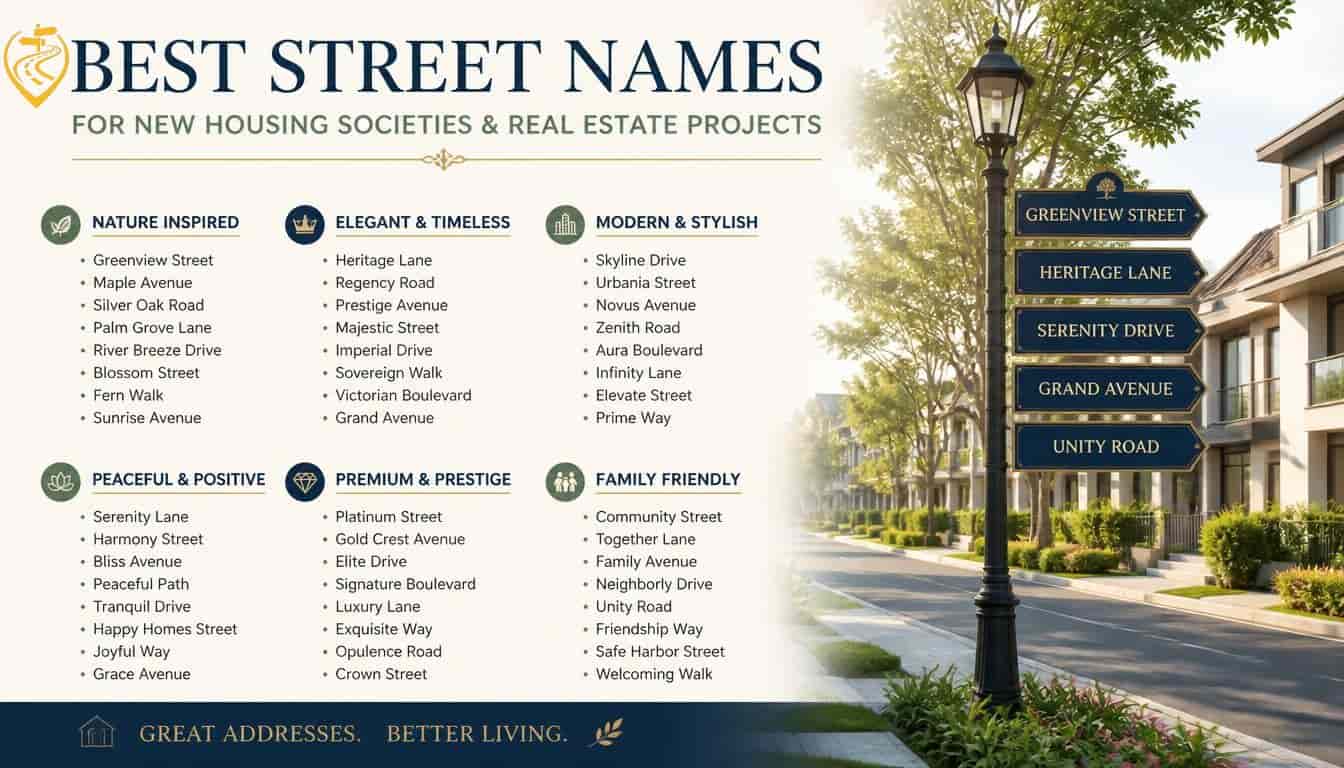
Choosing street names for a new housing society or real estate development is one of the most overlooked branding decisions in the entire project.
Buyers judge a community partly by how it sounds before they ever see the houses — “Maple Ridge Estates” already feels different from “Sector 14-B.”
Good street names shape first impressions, support marketing, and even affect resale value, while poorly chosen ones create navigation problems and generic, forgettable addresses.
This guide covers how developers and planners choose street names, the naming systems that work best for residential projects, and a categorized list of names ready to use for your next development.
Why Street Names Matter for Real Estate Developments
A housing society’s street names aren’t just addresses — they’re part of the product. Real estate marketing research consistently shows that buyers associate nature-themed and estate-style names (Willow Creek, Hidden Oaks) with premium, established neighborhoods, while numbered or generic grid names feel more utilitarian and budget-oriented.
Beyond marketing, well-chosen names also solve practical problems:
- Emergency response clarity — fire, police, and ambulance services need unambiguous, non-duplicate names
- Buyer memorability — a name that’s easy to say and spell helps with word-of-mouth referrals and online searches
- Long-term identity — the name often outlives the developer and becomes the community’s permanent identity
- Postal and GPS accuracy — names need to work cleanly in addressing systems, not just look good on a sign
How Developers Actually Choose Street Names
Street naming for a new development typically follows a structured process rather than random selection:
- Theme selection — the developer picks an overarching theme (nature, historical, geographic, or aspirational) that matches the community’s positioning and target buyer.
- Name generation — a batch of candidate names is drafted, usually more than needed, to allow for rejections during review.
- Duplication and phonetic check — local planning departments reject names that duplicate or sound too similar to existing streets in the same postal zone, since this creates emergency-dispatch confusion.
- Government/municipal approval — most jurisdictions require formal sign-off before names are recorded with postal services and mapping databases.
- Signage and marketing rollout — approved names are used consistently across signage, sales brochures, and digital listings.
The Best Street Naming Systems for Housing Societies
Nature and Landscape Themed
This is the most widely used system in modern residential development, and for good reason — it consistently tests well with buyers and is easy to scale across dozens of streets in one project.
Examples: Willow Creek Lane, Maple Ridge Drive, Hidden Oaks Court, Silver Birch Way, Meadowbrook Terrace
Estate and Prestige Themed
Used heavily in premium and luxury developments, this style borrows language associated with old-money estates and country properties.
Examples: Kingsbury Manor, Ashford Estate Drive, Grandview Court, Fairmont Chase, Wellington Grove
Heritage and Local History Themed
Naming streets after founders, historical figures, or local landmarks builds a sense of place and can strengthen a community’s identity, especially in established towns.
Examples: Founders Walk, Heritage Row, Old Mill Lane, Depot Street, Settlers Court
Geographic and Compass Themed
Common in larger master-planned communities where streets need to be easy to navigate at scale.
Examples: North Ridge Boulevard, Eastfield Drive, Highland Crossing, Sunrise Parkway, Lakeview Terrace
Aspirational and Lifestyle Themed
Popular in newer suburban developments targeting young families, this style leans on positive, forward-looking language.
Examples: Bright Horizon Way, New Beginnings Lane, Prosperity Court, Legacy Ridge, Harmony Grove
Naming Rules to Follow for a New Development
Most municipalities apply similar naming restrictions, so it’s worth checking these before finalizing any list:
- Keep names under roughly 15–20 characters so they fit on standard street signs and addressing systems
- Avoid names that sound phonetically similar to existing streets in the same zip code or postal zone
- Stay consistent with suffix conventions (Street, Lane, Court, Drive, Way) — many cities assign meaning to suffixes (e.g., Courts are typically short, dead-end streets)
- Avoid naming streets after living private individuals or active commercial brands, which most planning departments prohibit
- Maintain thematic consistency across the development — mixing unrelated themes across one project reads as unplanned
Quick Reference: 40 Ready-to-Use Street Names by Theme
| Nature/Landscape | Estate/Prestige | Heritage | Aspirational |
| Willow Creek Lane | Kingsbury Manor | Founders Walk | Bright Horizon Way |
| Maple Ridge Drive | Ashford Estate Dr | Heritage Row | New Beginnings Ln |
| Hidden Oaks Court | Grandview Court | Old Mill Lane | Prosperity Court |
| Silver Birch Way | Fairmont Chase | Depot Street | Legacy Ridge |
| Meadowbrook Terrace | Wellington Grove | Settlers Court | Harmony Grove |
| Cedar Hollow Lane | Buckingham Court | Millstone Row | Radiant Fields Dr |
| Sycamore Bend | Kensington Way | Cobblestone Lane | Golden Meadow Ln |
| Autumn Ridge Drive | Chatsworth Court | Homestead Trail | Sunny Slope Way |
| Bluebell Creek Ln | Windermere Estate | Pioneer Way | Aspire Court |
| Pinehaven Court | Sterling Manor Dr | Landmark Row | Bright Future Ln |
Frequently Asked Questions
Can a developer choose any street name they want? No — proposed names must go through local planning department review and are checked against existing names in the same postal zone before approval, largely for emergency-response safety reasons.
What makes a street name good for a housing society specifically? It should be easy to pronounce and spell, thematically consistent with the rest of the development, free of duplicates in the local area, and short enough to fit standard signage and addressing formats.
Should all streets in one development share a theme? Generally yes — thematic consistency (all nature-themed, all heritage-themed, etc.) reads as intentional planning and performs better with buyers than a mix of unrelated naming styles.
How many candidate names should a developer prepare? It’s common to prepare 30–50% more names than needed, since local approval boards frequently reject names for duplication or phonetic similarity to existing streets.
Need more options fast? Use the free Road Name Generator to generate hundreds of themed street names for your next housing project in seconds.