
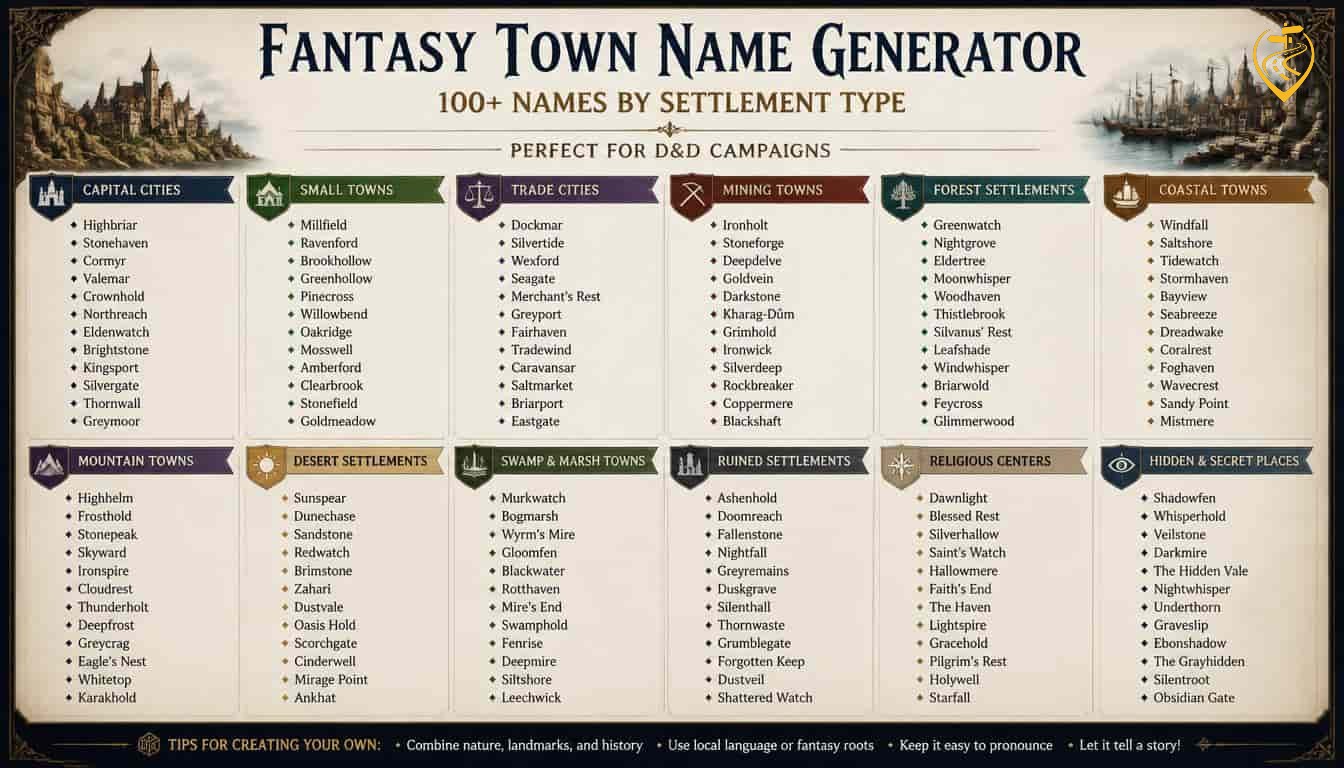
A strong fantasy town name combines a geographic feature (hollow, reach, vale, hold, mere) with a descriptive or thematic word (raven, ash, iron, mist, gold) — for example Ravenhollow or Ironhold.
The best names also hint at the settlement’s purpose: a mining town should sound different from a fishing village or a royal capital.
Use our free Town Name Generator to instantly create hundreds of names matched to your settlement type, culture, and tone.
What a Town’s Name Tells Players Before They Arrive
A city’s name is the first piece of information players get about it — often days of in-game travel before they actually walk through the gates. Ironhold sets up a fortified, industrial place before the DM says another word.
Willowmere promises something quieter, a village near still water where nobody’s in a hurry. That’s free worldbuilding: geography, economy, and mood compressed into one word.
This matters for Dungeon Masters improvising a homebrew world, novelists mapping a fantasy setting, and game designers populating an open world.
A well-chosen name signals this place was designed, even when it took thirty seconds to pick.
Matching a Name to the Settlement, Not the Other Way Around
Most naming mistakes happen backwards — picking a name that sounds cool, then trying to justify it. It works better in the opposite order. Before opening a generator, settle four things about the place:
Economy — What does the town live on? Fish, ore, timber, wool, or something rarer, like harvested magic.
Origin story — Was it founded, or did it survive something? Refugee settlements, ruins reclaimed, and sites blessed or cursed by a deity all read differently.
Terrain — Coastline, mountain pass, deep forest, open plain, or swamp shapes both the economy and the phonetics that fit.
Scale — A forty-person frontier hamlet and a royal capital shouldn’t share a naming register, even in the same kingdom.
Answer those four, then pick from the category below that matches. Each list draws on real place-name roots (Old English, Norse, and Celtic patterns), which is why the results sound like they belong on a map instead of a random word generator.
100+ Fantasy Town Names by Settlement Type
🐟 Fishing & Coastal Villages
Saltmere, Tidehaven, Greywater Bay, Netmoor, Crabshell Cove, Brinehollow, Fogharbor, Sealroost, Herring Point, Driftwick, Wavecrest, Kelpmarsh, Gullrock, Stormtide, Anchorfall, Mistdock, Shellbrook, Oarwick, Tarpool, Brackwater
Fits: coastal campaigns, pirate arcs, smuggler subplots, sea-monster hooks.
⛏️ Mining & Mountain Towns
Ironhold, Stonedeep, Emberpeak, Coalridge, Deepforge, Graniteholt, Ashcliff, Copperfall, Hammerhollow, Duskveil Mines, Bronzepeak, Cragmoor, Silverdelve, Slateshore, Orebrook, Flinthollow, Blackvein, Ridgeforge, Deephollow, Cinderpeak
Fits: dwarven settlements, underdark access points, dragon-lair-adjacent regions.
🌲 Forest & Woodland Villages
Thornwick, Mossfall, Duskgrove, Fernhollow, Willowmere, Shadowoak, Brackenwood, Elderleaf, Ravenwood, Mistgrove, Wolfden, Greenhollow, Hazelbrook, Gladewick, Vinewatch, Owlreach, Timberhollow, Foxglen, Brambleford
Fits: elven or druidic settlements, ranger-guild towns, fey-touched regions.
🛒 Trade Hubs & Crossroads Towns
Merchant’s Rest, Crownroad, Goldmarket, Tollbridge, Wayfarer’s Cross, Coinhaven, Lanternmarch, Traders’ Gate, Fairwind Crossing, Spiceport, Caravan’s End, Wheelwright, Marketstead, Crossvale, Kingsroad Junction, Bartertown, Freehold, Amberway
Fits: neutral factions, thieves’ guild bases, information-broker NPCs.
👑 Capital Cities & Kingdoms
Aldenreach, Duskmere, Highspire, Crownhaven, Silvergate, Emberfall Citadel, Thornecrest, Valorhold, Goldspire, Stormwatch, Ravensguard, Winterhall, Sunspire Keep, Ironthrone, Moonreach, Starfall City, Ashenvale, Highcourt
Fits: royal intrigue campaigns, main-quest hubs, high-level content.
💀 Cursed & Ruined Settlements
Blightmarsh, Graveshade, Ashfall Reach, Hollowgrave, Rotwood, Crowscry, Deadmire, Witherhold, Bonecross, Fogrot, Nightgrave, Shadowmire, Cindermoor, Grimhaven, Wraithhollow, Ashenroot, Cursebrook, Ghostvale
Fits: horror one-shots, undead campaigns, dungeon-crawl entry points.
Why These Names Sound Real: The Structure Underneath
Every list above leans on the same handful of building blocks real place names use — which is exactly why players don’t question them:
- Landscape word as suffix: -hollow, -mere, -reach, -vale, -holt, -moor. English towns like Bournemouth or Sherborne follow this same logic.
- Resource or trait + geographic noun: Ironhold, Silvergate — the medieval habit of naming a place after what it produces or guards.
- Fused compound descriptives: Duskmere, Fogharbor — two ordinary words pressed together until they stop sounding ordinary.
Once you can spot these patterns, you can build endless names by hand. Take a cursed-settlement prefix like Shadow- or Wraith- and graft it onto a coastal name, and you get a haunted fishing village for free: Wraithtide, Shadowmere.
Connecting a Town’s Name to What’s Inside It
A town’s name works best when it sets the tone for everything inside it — starting with its streets.
Tidehaven should have roads like “Netmaker’s Row” or “Gullwatch Lane.” Hollowgrave calls for something like “Crowfeather Alley” or “Bonecross Path” — not a cheerful “Sunpetal Lane” that clashes with the town’s whole identity.
Our companion piece, How to Name Streets in Your D&D Campaign World, covers that layer in full, with 100+ street names sorted the same way.
The two only work together if the tone carries through — a grim town with whimsical street names (or the reverse) undercuts both.
When You Need Names Faster Than You Can Write Them
Building a naming system by hand works fine for a single town. It stops working the moment you’re prepping a hexcrawl with fifteen settlements, or mapping an entire continent for a novel.
For that scale, our free Town Name Generator filters by cultural style, settlement size, and tone (peaceful, dangerous, mystical) and returns names ready to drop onto a map — no manual pattern-matching required.
Frequently Asked Questions
How is naming a town different from naming a street?
A town name has to represent an entire settlement’s history, economy, and geography in one word. A street name only has to fit one road within it. Get the town right first — the streets follow its tone.
What’s the fastest way to pick a town name during a live session?
Grab one from the settlement-type list that matches the terrain your players are approaching, and adjust the ending if it’s already been used elsewhere in your world.
Are these names usable in a published book or commercial game?
Yes — every name here, and everything the generator produces, is free to use in personal and commercial creative work, including published fiction and released games.
How many different town names does the generator produce?
It draws from a pool of 10M+ combinations across cultural styles, so a long-running campaign is very unlikely to hit a repeat.
Should a capital city and a nearby village share naming conventions?
Not necessarily. A kingdom can have regional naming dialects the same way real countries do — a coastal province and a mountain province in the same nation can sound distinct without breaking believability.