
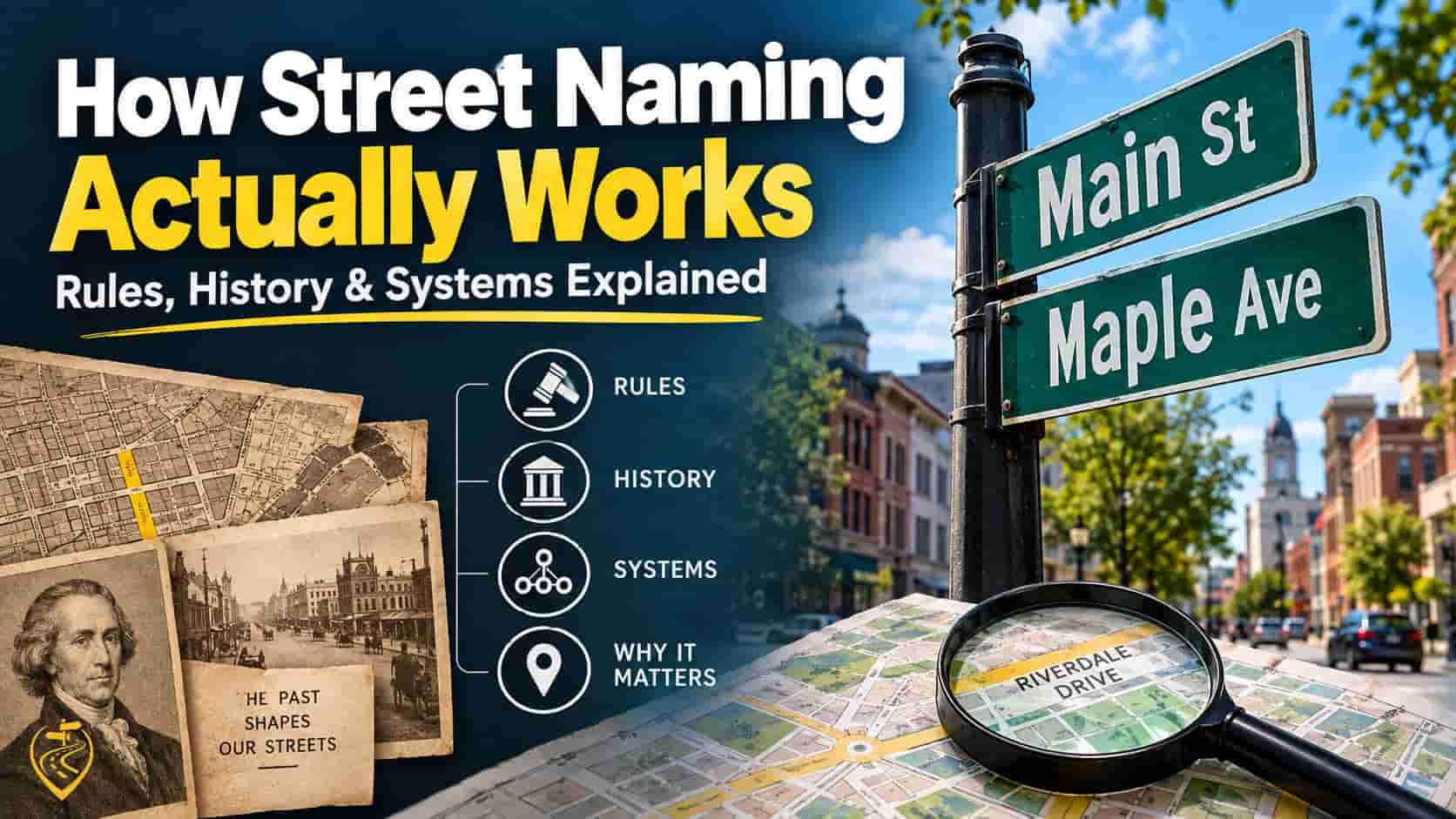
Every street has a name — but almost nobody stops to ask who chooses it, what rules govern it, or why some cities end up with “5th Avenue” while others get “Whispering Pines Lane.”
Street naming is a real administrative discipline with its own history, legal framework, and modern systems, and understanding it helps explain everything from why your GPS sometimes struggles to why fantasy world-builders and game designers work so hard to make invented street names feel authentic.
This guide breaks down exactly how street naming works — from the historical roots of the practice to the modern rules city planners follow today.
What Is Street Naming and Why Does It Matter
Street naming is the formal process of assigning a unique identifier to a public or private road so it can be located, navigated, mapped, and referenced in legal and emergency contexts. It sounds simple, but a street name does several jobs at once:
- It gives emergency services (police, fire, ambulance) a precise location to respond to
- It supports mail delivery, GPS navigation, and postal addressing systems
- It preserves local history, geography, or culture
- It creates a sense of identity and character for a neighborhood
Because street names carry legal and safety weight, most local governments treat naming as a formal process rather than something left to chance or personal preference.
The History of Street Naming
Ancient and Medieval Origins
Early street names weren’t formally assigned — they emerged organically from how people used a location. A street lined with bakers became “Baker Street.” A road leading to a market became “Market Street.”
A path to a mill became “Mill Lane.” This descriptive naming pattern is one of the oldest in urban history and still shows up constantly today.
The Grid System and Numbered Streets
As cities grew during the 18th and 19th centuries, especially in North America, planners began favoring numbered and lettered grids over descriptive names.
Manhattan’s grid plan (1811) is the most famous example — numbered streets running one direction, numbered avenues running the other.
Grid systems made new development faster to name and easier to navigate, since visitors could estimate distance and direction just from the numbers.
The Rise of Themed Suburban Naming
By the mid-20th century, suburban housing developments introduced a new pattern: themed naming, where every street in a subdivision shares a common word or category — think “Oakwood Drive,” “Oakwood Court,” and “Oakwood Circle” in the same development.
This is now one of the most common naming systems in the world, largely because it’s easy for a single developer to generate dozens of related, appealing names at once.
Who Actually Names Streets Today
In most countries, street naming isn’t arbitrary — it goes through a defined civic process:
- Developer or property owner proposes names for new streets in a subdivision or development, usually as part of the site plan submitted for approval.
- Local planning or public works department reviews the proposal against naming rules (covered below) and checks for duplicates.
- Emergency services (911/999 dispatch, fire department) sign off, since duplicate or confusing names create real safety risks.
- City council or county board formally approves the name, often as part of a subdivision plat or ordinance.
- The name is recorded with the postal service, GIS mapping systems, and emergency dispatch databases.
Some cities also allow public petitions to rename existing streets — usually to honor a person, mark a historic event, or remove a name the community no longer wants associated with the area.
The Rules Behind Street Naming
Most municipalities publish formal naming guidelines. While they vary by country and city, the core rules tend to repeat almost everywhere:
- No duplicate names within the same city or postal zone. Two “Main Streets” in one jurisdiction is a genuine emergency-response hazard.
- No names that sound alike. “Kingston Ave” and “Kingsley Ave” can be confused over the radio or by GPS, so many cities reject names that are phonetically too close to existing ones.
- Length limits. Names are often capped around 15–20 characters so they fit on street signs and in addressing databases.
- No offensive, political, or commercially promotional names. Most cities prohibit naming streets after living private businesses or using names that could be considered inappropriate.
- Directional consistency. Suffixes like Street, Avenue, Boulevard, Lane, and Court are frequently standardized to indicate direction or road type (e.g., avenues run north-south, streets run east-west in a grid city).
- Historical or thematic continuity. Many cities require new names to fit an existing theme in that area (trees, local history, geographic features) to keep neighborhoods coherent.
Common Street Naming Systems Around the World
| System | How It Works | Where It’s Common |
| Numbered grid | Streets and avenues numbered sequentially | US cities (NYC, Salt Lake City, Chicago) |
| Descriptive/occupational | Named after historical use or trade | UK, older European cities |
| Themed subdivision | Shared word/category across a development | US and Canadian suburbs |
| Honorary | Named after notable people or events | Worldwide, especially post-independence nations |
| Directional/compass | Named by cardinal direction or relative position | Planned cities, military bases |
| Postal code-based | Numeric-only addressing tied to postal zones | Japan (in some areas), parts of rural US |
Why Street Naming Matters for Writers, Game Designers & World-Builders
If you’re building a fictional city — for a novel, a tabletop campaign, or a video game — real-world street naming logic is exactly what makes invented names feel believable.
A fantasy city with a “Thornwood Quarter” full of streets like Thornwood Lane, Thornwood Court, and Thornwood Row mirrors real suburban theming.
A grim, industrial district reads more authentically with descriptive, trade-based names like Ashmill Row or Tannery Street than with generic fantasy words.
This is exactly the logic behind a good street name generator — the best invented names borrow real naming patterns (descriptive, themed, directional, or honorary) rather than being random word combinations.
Frequently Asked Questions
Q.Can residents choose the name of their own street?
Rarely on their own — but residents can usually petition their local government, and developers typically propose names for brand-new streets as part of the approval process.
Q.Why do some streets have the same name in different parts of the same city?
This usually happens in cities that were once separate towns before merging, or where naming rules weren’t strictly enforced historically. Modern cities actively work to eliminate duplicates because of the emergency-response risk.
Q.What’s the difference between a Street, Avenue, and Boulevard?
There’s no single global rule, but common conventions are: Streets often run perpendicular to Avenues, Boulevards are typically wide roads with medians or trees, Lanes and Courts are usually short or dead-end residential roads, and Drives often follow a natural feature like a river or hillside.
Q.Do all countries follow the same naming rules?
No — naming conventions vary significantly by country and even by city. Grid numbering is common in North America, descriptive and historical naming is more common in Europe, and some regions use block-and-number addressing instead of named streets at all.
Need names for a fictional street, city, or game world? Try the free Road Name Generator to generate authentic-feeling street names in seconds.