
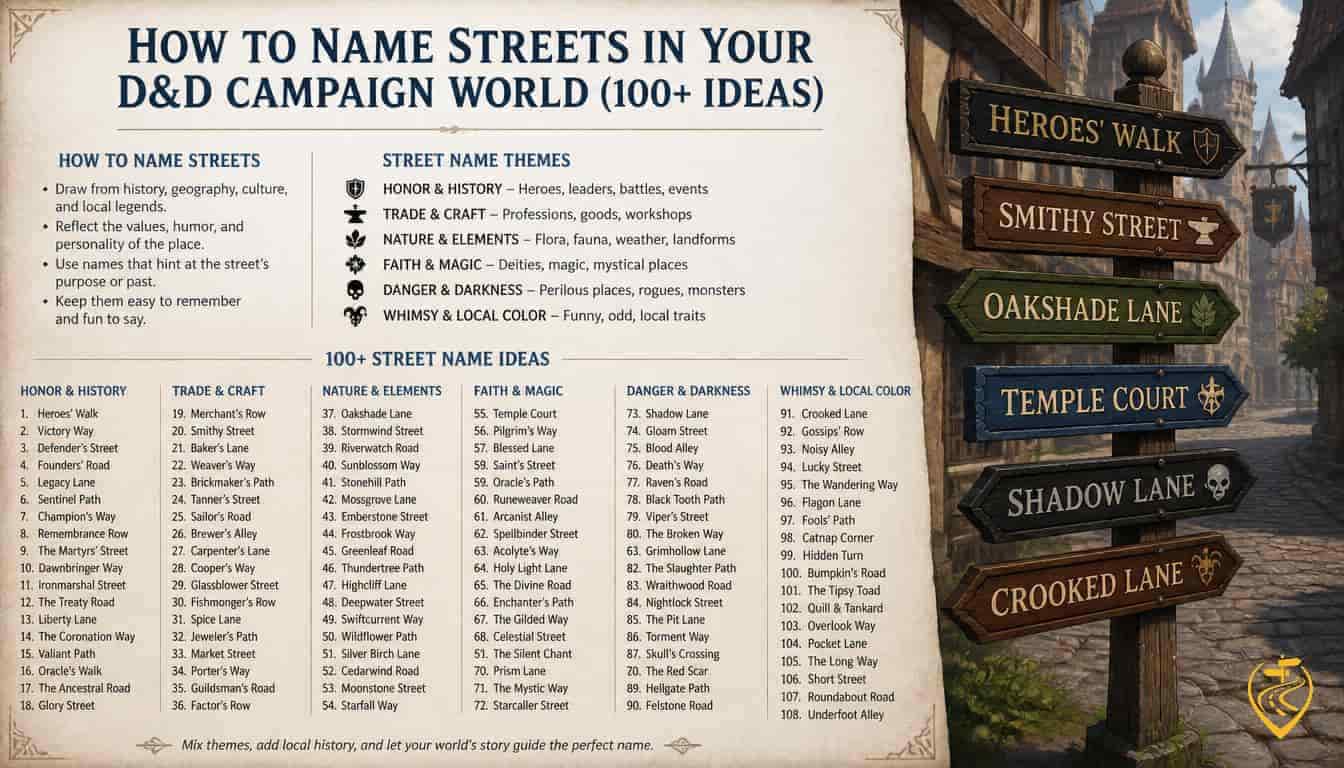
Every great D&D city needs streets that feel alive — not just “Main Street” copy-pasted from the real world.
Whether your players are sneaking through a slum district or strolling past noble estates, the names of the roads they walk on quietly build immersion.
Yet street naming is one of the most overlooked parts of worldbuilding, usually left for the moment right before a session when the DM is already scrambling.
This guide breaks down exactly how to name streets for your campaign world — with formulas, examples, and a free tool to generate hundreds of options instantly.
Why Street Names Matter More Than You Think
Players remember details that feel intentional. A tavern on “Ashfall Row” hints at fire, war, or ruin before a single line of dialogue is spoken.
A district called “Coinpurse Lane” tells players exactly what kind of business happens there. Good street names:
- Reinforce the tone of a district (wealthy, dangerous, magical, industrial)
- Give players quick spatial orientation during exploration or combat
- Add flavor text for maps, handouts, and NPC dialogue
- Make your world feel lived-in rather than generated on the fly
The Core Naming Formulas DMs Actually Use
Most memorable fantasy street names follow one of these patterns. Mix and match to fit your setting.
1. Descriptor + Object
Combine an adjective with a physical noun. Examples: Ravenwood Alley, Ironhook Street, Duskmoor Lane
2. Trade or Guild-Based
Base the name on what happens there — useful for market districts. Examples: Cobbler’s Row, Silversmith Way, Tanner’s End
3. Historical or Event-Based
Reference a past battle, disaster, or founder. Examples: Widow’s March, Founder’s Gate, The Burning Path
4. Nature and Geography
Great for elven, druidic, or rural settlements. Examples: Willowbrook Path, Mossfall Trail, Thornvale Road
5. Ominous or Dark Fantasy
Perfect for slums, cursed districts, or horror-themed campaigns. Examples: Gallows End, Bonepicker Alley, Sorrow’s Hollow
Naming Streets by District Type
| District Type | Style to Use | Example Names |
| Noble Quarter | Elegant, historical | Ashworth Boulevard, Regent’s Row |
| Market District | Trade-based | Spicewell Lane, Coinpurse Alley |
| Slums/Docks | Gritty, ominous | Rustwater Row, Beggar’s End |
| Magic District | Mystical, abstract | Emberglass Way, Runecross Path |
| Rural Village | Nature-based | Barleyfield Lane, Hollowbrook Trail |
Keeping a consistent naming style per district (not per city) is what makes a map feel designed rather than randomly generated.
Naming Streets by Culture & Race
Different fantasy races and cultures should sound distinct. Reusing the same naming style for an elven forest city and a dwarven mountain hold breaks immersion fast. Here’s a quick breakdown DMs can copy directly:
Elven Streets — soft, flowing, nature-linked Examples: Sylvaleaf Path, Moonwhisper Trail, Aeloria Way
Dwarven Streets — hard consonants, stone/metal roots Examples: Grimforge Row, Stonehammer Alley, Ironvein Street
Orcish/Goblin Streets — blunt, aggressive, short Examples: Skullcrusher Road, Gutstreet, Bonepile Lane
Human (Medieval) Streets — trade or geography-based, most “real world” feeling Examples: Millpond Lane, King’s Bridge Road, Oxcart Street
Draconic/Ancient Streets — long, syllable-heavy, ceremonial Examples: Vhaelorath Passage, Drakmoor Ascent
A simple rule: if a district is home to a specific race or culture, borrow its phonetic patterns (hard consonants for dwarves, soft vowels for elves) rather than inventing something unrelated. This alone makes a map feel far more intentional.
Common Mistakes DMs Make When Naming Streets
Even experienced DMs fall into a few repeatable traps:
- Overcomplicating names. A street called “Xyndrathorial Way” might look impressive on paper but becomes a nightmare to say out loud at the table three sessions in a row. Simpler is almost always better.
- Using modern names by accident. “5th Avenue” or “Main Street” breaks immersion instantly in a fantasy setting — always give even mundane streets a light fantasy filter.
- Naming everything at once. Players rarely explore an entire city in one session. Name only the streets your players will actually walk down; generate the rest on demand.
- Inconsistent tone within one district. Mixing “Sunpetal Lane” (whimsical) with “Gutrender Row” (brutal) in the same wealthy quarter confuses the district’s identity.
- Forgetting to reuse names. Real cities repeat root words across many streets (all the “-ford” or “-wick” towns in England, for example). Fantasy cities should do the same for believability.
A Quick Worldbuilding Tip: Layer in History
The fastest way to make a street name feel real is to attach a one-sentence backstory, even if you never share it with players directly:
“Widow’s March got its name after the town’s men marched out to war and never returned.”
You don’t need this for every street — just 2-3 “hero” names per city that you can drop into dialogue when needed.
Skip the Guesswork: Generate Names Instantly
Coming up with dozens of consistent, lore-appropriate street names on the fly is genuinely hard — especially mid-session.
That’s exactly why we built the DnD Campaign Name Generator, a free tool that instantly generates fantasy street, tavern, and district names by tone (dark, noble, rural, magical, and more).
Features DMs actually use:
- Filter by fantasy tone or district type
- Save favorites for later sessions
- Export a full list as CSV/TXT for your campaign notes
If you’re also naming characters, NPCs, or dragons for the same world, check out our Dragon Name Generator and First Name Generator to keep your entire setting consistent.
Final Tips for Consistent Fantasy Street Names
- Pick 2-3 naming formulas per city and stick to them — don’t mix noble and gritty names in the same district.
- Say every name out loud. If it’s hard to pronounce at the table, simplify it.
- Reuse root words (Ash-, Thorn-, Iron-, Moss-) across a city to create a sense of shared culture or language.
- Don’t over-explain. A good name implies history; you don’t need to justify all of them.
Ready-made lists save time — but a tool built specifically for fantasy settings saves even more. Try the generator above and drop a fully-named district into your next session in minutes.
FAQs
Q.What makes a good D&D street name?
A good street name is easy to pronounce, hints at the district’s tone or history, and stays consistent with the naming style of nearby streets in the same city.
Q.Is there a free tool to generate D&D street names?
Yes — the DnD Campaign Name Generator creates instant fantasy street and district names filtered by tone, with export and favorites features, completely free.
Q.Should every street in my campaign have a name?
No. Only name streets your players are likely to visit or reference. Keep a short list of “hero” names ready and generate the rest on the fly as needed.
Q.How do I make elf, dwarf, and orc streets sound different?
Match the culture’s phonetic pattern — soft, flowing names for elves, hard consonant names for dwarves, and blunt, short names for orcs or goblins — rather than reusing one style across all races.
Q.Can I use real-world street naming conventions in fantasy settings?
Yes, with a fantasy filter. Trade-based names (Cobbler’s Row), geography-based names (Millpond Lane), and historical names (Founder’s Gate) all mirror real medieval naming logic and feel authentic in-game.
Conclusion
Naming streets might seem like a small detail, but it’s one of the easiest ways to make a fantasy city feel real instead of randomly generated.
Stick to 2-3 naming formulas per district, match names to the culture or race that lives there, and don’t be afraid to reuse root words the way real cities do.
You don’t need to name every alley — just the ones your players will actually walk down.
And when you’re short on time before a session, you don’t have to build a list from scratch.
The DnD Campaign Name Generator gives you dozens of consistent, lore-ready street names in seconds, so you can spend more time running the game and less time staring at a blank page.