
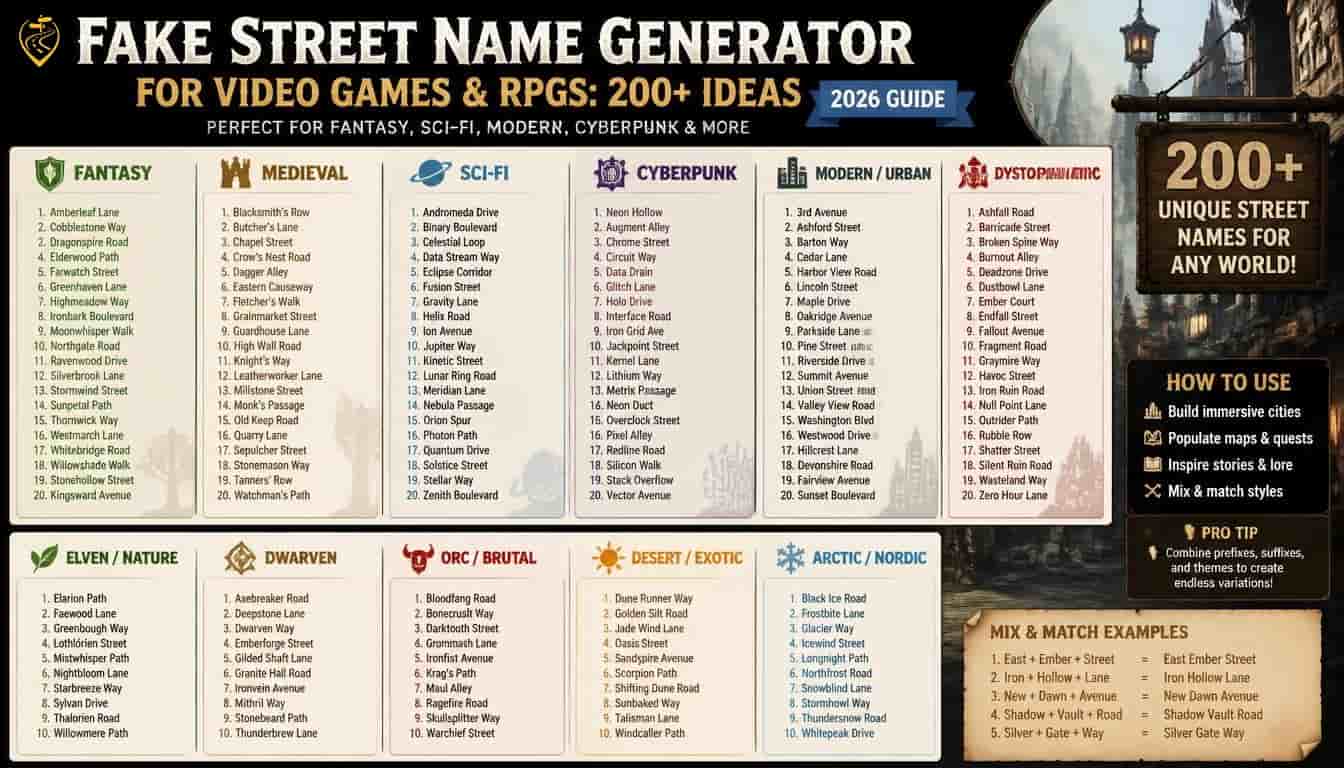
Fake Street Name Generator for Games
Unlike naming a single real-world street, game designers often need to populate an entire fictional map — dozens or hundreds of streets across districts, genres, and tonal shifts, all invented from scratch.
This guide is built specifically for that use case: generating fake street names at scale for video games, tabletop RPGs, and open-world design, using a dedicated street name generator instead of manually inventing each one.
Every believable game world needs streets that feel like they belong there — not generic placeholders, but names that hint at history, culture, and the people who supposedly named them.
Whether you’re building an open-world city, designing a tabletop RPG map, or coding a procedurally generated town, fake street names are one of the smallest details that carry outsized weight in how “real” a world feels to players.
This guide covers how to create fake street names that work across different game genres, the naming patterns that make them believable, and how to generate them quickly using a dedicated tool instead of inventing each one by hand.
Quick Answer: Fake street names for games are invented road, avenue, and district names designed to sound authentic within a fictional setting. They’re built using real-world naming patterns — geography, historical figures, local landmarks, or thematic keywords — adapted to fit a game’s tone, whether that’s a gritty cyberpunk city, a medieval fantasy kingdom, or a suburban horror setting.
Why Street Names Matter in Game Design
Street names are environmental storytelling in miniature. A player who sees “Ashfall Row” in a post-apocalyptic game absorbs tone and history without a single line of dialogue.
A cul-de-sac called “Marigold Court” in a horror game creates unsettling contrast between suburban normalcy and whatever’s actually happening there.
Game designers use street names the same way novelists use setting details — as compressed worldbuilding that players notice subconsciously even when they’re not reading every sign.
This is especially true in open-world and sandbox games, where hundreds of streets need names, and in tabletop RPGs, where a Dungeon Master often has to improvise a town’s geography on the spot.
Types of Fake Street Names by Game Genre
Open-World / Sandbox Games
These benefit from names that feel geographically consistent — grouped by district, referencing local industry, geography, or founding history, similar to how real cities organically develop naming patterns over time (e.g., “Ironworks Lane” near an industrial district, “Harbor View Street” near a coastline).
Fantasy / Medieval RPGs
Fantasy street names often lean on old-world phrasing and craft-based naming — “Cobbler’s Row,” “Ashwood Path,” “King’s Landing Street” — reflecting how medieval towns were frequently named after trades, guilds, or notable landmarks.
Cyberpunk / Sci-Fi Settings
Futuristic settings tend to favor corporate, numbered, or tech-adjacent names — “Sector 9 Boulevard,” “NeoCorp Way,” “Data Spire Avenue” — reinforcing a world shaped by corporations or advanced technology rather than organic history.
Horror Games
Horror benefits from unsettling contrast: names that sound wholesome, pastoral, or nostalgic against a backdrop of dread — “Hollow Creek Lane,” “Willowbrook Court,” “Quiet Hollow Road.” The unease comes from the mismatch between name and atmosphere.
Western / Frontier Settings
These favor blunt, functional naming rooted in geography or early settlement history — “Dustbowl Trail,” “Miner’s Gulch Road,” “Old Wagon Path.”
Fake Street Name Types at a Glance
| Game Genre | Naming Style | Example |
| Open-World/Sandbox | Geographic, district-based | Harbor View Street |
| Fantasy/Medieval | Trade or landmark-based | Cobbler’s Row |
| Cyberpunk/Sci-Fi | Corporate, numbered, technical | Sector 9 Boulevard |
| Horror | Pastoral names with dark contrast | Hollow Creek Lane |
| Western/Frontier | Functional, geography-driven | Dustbowl Trail |
How to Create Believable Fake Street Names
- Root the name in your world’s internal logic. Real street names usually reference something — a founder, a geographic feature, an old industry, or a historical event. Decide what your world’s naming logic is before generating names, and stay consistent with it across your map.
- Use suffixes deliberately. “Street,” “Avenue,” “Lane,” “Court,” “Row,” and “Boulevard” all carry subtly different connotations — avenues and boulevards suggest scale and importance, while lanes and courts suggest smaller, quieter areas. Matching suffix to location size adds subconscious realism.
- Avoid overly cartoonish or joke names — unless that’s the tone. Names like “Punmaster Street” can work in a comedic game but will break immersion in a serious RPG or horror title. Match the naming style to the emotional register of the game.
- Group names by district or zone. Real cities cluster similar naming themes by neighborhood — industrial areas often share utilitarian names, older districts often share historical or founder-based names. Applying this pattern to a fictional map makes procedurally generated cities feel less random.
- Test names within game context, not in isolation. A name might read well on a list but feel out of place on an in-game sign, map marker, or NPC dialogue reference. Always sanity-check chosen names against how they’ll actually appear to players.
Using a Fake Street Name Generator Efficiently
For games with dozens or hundreds of streets — especially procedurally generated open worlds — manually inventing each name isn’t practical.
A street name generator filtered by cultural style, suffix type, and naming pattern can produce a large, varied pool quickly, which can then be curated or lightly edited to fit a specific district’s theme.
The most efficient workflow is generating in batches by district: run one batch for the industrial zone, another for the historic district, another for the suburbs — rather than generating names randomly and trying to sort them afterward.
Frequently Asked Questions
Q.What makes a fake street name sound realistic?
A realistic fake street name typically references something concrete — geography, a founder’s name, a historical trade, or a landmark — combined with a suffix that matches the street’s scale. Names that feel arbitrary or overly generic (“Main Street,” used everywhere) tend to break immersion faster than inventive ones.
Q.How many street names does an open-world game usually need?
This varies widely by map size, but mid-size open-world districts often require 50–200 unique street names, while a full city-scale map can require several hundred, which is why generator tools are commonly used over manual naming.
Q.Can fake street names be used for tabletop RPGs, not just video games?
Yes. Dungeon Masters and tabletop game designers frequently use fake street names to build believable towns and cities on the fly, particularly during improvised sessions where a fully mapped setting hasn’t been pre-written.
Q.Should street names match the game’s real-world inspiration?
If a game is loosely based on a real city or region (a fictional version of 1920s Chicago, for example), street names should reflect that era and culture’s naming conventions to reinforce authenticity, even though the names themselves are invented.
Q.What’s the difference between a fake street name and a real one used in fiction?
A fake street name is entirely invented for the fictional setting, while some games and stories borrow real street names for grounding or homage. Most game designers prefer fully invented names to avoid confusion with real-world locations and to maintain creative control over tone.
Generate Fake Street Names Instantly
Use the Road Name Generator above to create hundreds of fake street names filtered by cultural style, suffix, and pattern — perfect for open-world maps, RPG towns, or any fictional setting that needs streets with real personality.
Explore More Generators: